Showing posts with label Poverty. Show all posts

Thursday, December 8, 2011

THE NEW FACE OF POVERTY

Subnitted by: Hoang Nguyen

Does the unequal distribution of income in a society pose an additional hazard to the health of the individuals living in that society?  It is widely acknowledged that individual income is a powerful determinant of individual health. Health is related to both quantitative and qualitative aspects of material and social changes. Poverty is a risk factor for premature mortality and increased morbidity. How does it affect poor people? Why does it affect them?

 When people are poor, they often have a lot of things to worry about because they are lacking money, resources, prestige, education, or family support.  When people are under stress, they tend to make poor food choices.  Unfortunately, these food choices can create more stress in the long run as well as other health problems like obesity, heart disease, high blood pressure, and depression.  They also have bad habits such as drinking too much coffee or alcohol, excessive smoking, and eating food high in sugar and fat.
 great depression


Poor people being skinny were already unusual twenty years ago.

 overweight girl


   This is what new poverty look like today.

The tallest bar of the left represents the lowest income group and the highest race of obesity.

 Table - percentage of adults

Logically, that doesn’t make sense and it contrary to our historical experience. How can they be the most likely to overweight with the least money on spending?  There are many reasons. Some focus on the foods. In a New York Times article, author Michael Pollan asks this very question…
“Compared with a bunch of carrots, a package of Twinkies is a highly complicated, high-tech piece of manufacture, involving no fewer than 39 ingredients, many themselves elaborately manufactured, as well as the packaging and a hefty marketing budget. So how can the supermarket possibly sell a pair of these synthetic cream-filled pseudo-cakes for less than a bunch of roots?

Pollan goes on to answer his own question…

“The Twinkie is basically a clever arrangement of carbohydrates and fats teased out of corn, soybeans and wheat — three of the five commodity crops that the farm bill supports, to the tune of some $25 billion a year.”

The most unhealthy foods and fattening  are the most cheapest food. Some reasons focus on the people.  Poor people are often uneducated, or too lazy to exercise, or just too busy working two jobs to have time to exercise. In addition, many poor neighborhoods don't have safe places in which to exercise. Poor neighborhoods have many fast food advertisements and restaurants.  If you are poor and hungry, you will buy the cheapest calories.  If you eat that type of food until you no longer feel hungry, you're eating too many calories.  In many cases, that's why poor people are fat.  Hunger is deeply wired into the human brain.  It doesn't just depend on getting enough calories.  Among other things, it depends on getting all the important nutrients.  It is especially sad because it is impossible to have a good healthy diet cheaply.  You have to take the time, have access to a kitchen, and to fresh fruit and vegetables.  However, most poor people don't have the time, or are not able to afford these fresh foods. 


We are what we eat so food is really an important matter.  "We" are the main factor that plays an important role in our own health.  No matter if we are rich or poor, we have to start educating ourselves and the next generation about living a healthy lifestyle.  It's not easy, and it will take a lot of efforts from the big corporations, the community and the government to create a new healthy and safety environment. We must start now!

Friday, November 4, 2011

America the Land of Contradictions


Submitted by Imane Khaddouch
          Poverty is a universal phenomenon that exists in all nations and can be obviously seen in our quotidian life through hungers and homeless people. Even in the most sophisticated countries, like The United States, there are many people who struggle to maintain the basic standard of living, while a little  portion of society monopolize wealth, prestige and power. According to Schaefer, the U.S Census Bureau reported that “one in five households has trouble meeting basic needs, from paying the utility bills to buying diner.”             
          The American society is a mixture of different races and cultures who brings with them the hope to find better opportunities to live better and realize the American dream. Unfortunately, many people fail to realize even the moderate dreams because of the inequality of opportunities or sometimes the hard luck. But, the inevitable truth is that there are many people who are ingrained in poverty and live a marginalized life.  In fact, even middle class people can experience poverty when they can’t afford their credit card bills, home mortgages and medical bills (in the absence of health insurance). Furthermore, many hardworking people lost their beautiful houses through mortgage foreclosures as they can’t pay their monthly mortgage, which is unfair punishment.

Child Poverty
Poverty  continues to rise by over 40% as result of spending cuts and sharpest fall in incomes in 35 years, IFS Report Warns

Class Warfare
The picture shows the high income inequality that helped early societies spread.

 Homelessness is one of the most dramatic aspects of poverty that is a real reality in the American society; however, wealthy people enjoy the luxury life. Every time you walk in the street, you will see victims of poverty, who are usually elderly people, who don’t have a permanent shelter or even food. Paradoxically, upper class families spend a lot of money to buy pets` food. Furthermore, the working class also struggles to afford a decent living because they support a huge family or they get low wages.
the following video talks about how the U.S poverty rate continues to raise.
The stratification of the American society becomes more and more obvious.  The inequality of access of education and medical coverage increase the gap between the upper class and the lower class.  Indeed, poor people should be aware of their rights as American citizens and have equal opportunities as the wealthy people have. On the other hand, they also should consider the importance of getting higher education, which is the key of success in the U.S. It is shameful to blame poor individuals about their situation, instead, we should give them a hand to improve their social situation and give them the hope to have a better future for them and their children.

Thursday, November 3, 2011

Poverty in the world

Submitted by: Amira Eldisoky
          Samar Wahba is a Lebanese mother who abandoned her son and left him in front of a hospital because of poverty. That single mother who has five children was not able to afford the cost of the healthcare for her sick child. She said "I hope if I can get him back to me again, and I regret what I did, but that was for him. If he stayed with me, he would be dead.” That story is one of millions stories that poverty creates every day. The Lebanese mother lost two daughters because she was disabling to provide them the medicine and the food that could save their lives, and she made the decision to leave her son to save his life. Poverty rolled individuals’ lives and force them to do unexpected behavior such as Samar when she decided to leave her child to someone else to take care of him to save his life instead of raising him and see him growing up in front of her eyes. 
          "The world today has become an island of the rich surrounded by a sea of ​​the poor" as the description of South Africa President, "Mbeki" last year at the Earth Summit in Johannesburg about poverty which increase day after day, despite the progress that made by individuals in various fields, and despite their effort to provide welfare for the six billion people in the world. The United Nations Day is 17 October of this year has just passed with no changes in the situation but only adds another year full of death, disease and hunger to the age of the world's poor. The questions that everyone wondering everyday are, Has poverty in the world became really a dangerous issue? What are the underlying causes of this dilemma? Are the rich people in the world make any effort to solve this problem? Are there any hidden results of this phenomenon more than hunger, disease and death?
          There are 6 billion people living in the planet. 4.3 billion who live in the developing countries and 3 billion of them lived below the poverty line as low as two dollars a day, and among these there are 1.2 billion earn less than 1 dollar a day. In contrast, statistics show Western terms as the industrialized countries have 97% of privileges all global, and international and intercontinental companies owns 90% of the privileges of technical, production and marketing. Moreover, more than 80% of the profits of the total foreign direct investment in developing countries go to 20 rich countries.
           In developing countries, we find that the rate of 33.3% of people has no clean drinkable water, and 25% don't have adequate houses. 20% don't have basic health care standard, and 20% of children do not attend schools for more than the fifth grade. And 20% of students suffer from poverty and undernourishment. In contrast, the wealth of three richest men in the world is equivalent to the GDP of the poorest 48 countries in the world, and the wealth of 200 of the world's richest people exceed the income rate of 41% of the population of the world combined. Studies show that if they contributed 1% of this wealth will cover the cost of primary education for all children in the developing world. While the die of 35 thousand children a day because of hunger, disease, and poverty.
             All of these numbers show the disorder in the concentration of global capital, a disorder cannot be ignored from our side because it has negative effects on humans which seriously threaten the Social Peace. Poverty is a global problem which leads to hunger, homelessness, ignorance, and death. Also, nowadays, it became a dangerous issue that threatened the Middle-class people that they can become poor under any circumstances as consequences of economic crises and financial issues. Also, in developing countries, poverty increases not only because of ignorance, backwardness and lack of democracy, but also because most these countries wealth goes into the pockets of the rich which make the rich richer and the poor poorer.

Wednesday, August 24, 2011

Poverty And How It Effects The Youth

Submitted By Vincente` Thompson


The school district of Philadelphia has a bout 180,000 children attending school. Now if you believe that the youth is the future and education is the key to success. Then this may come to an alarm to you. 30% of the children in the school district live in poverty and 9% experience homelessness. This is a major concern for the students of the school district also a major concern with the future of our society.

Here are two quick facts, more than three-fourths of the children who attend Philadelphia public schools qualify for free or reduced price lunch. Also 74 of 267 Philadelphia District schools, over 90 percent of the student body qualifies for free or reduced price lunch. What this means is that children goin to these school either live under the poverty line or right above it.

Now facts show that hungry undernourished children will not do well in school.Children in schools coming from poverty stricken homes are less like to graduate, have academic struggles, behavior problems in classroom settings, and truancy. These children living in poverty are not getting the right amounts of food on a daily basis so this causes the brain to not grow because the body is not getting the right amount of nutrients it needs.
In conclusion the poverty in the city of Philadelphia is only becoming a bigger problem. For to long the issue is not being addressed and just over looked as if its not important. When in reality it effects the children growing up in poverty who are the future of our society. And  as the children of our Philadelphia school district grow older and become adults it still effects them because they may still continue to live in poverty. If the children of our future are not being nourished and are not growing properly how can we as a society expect any change for the future

Sunday, August 21, 2011

Struggle within America's Poverty

Submitted by A.Marshall
8/21/11

Over the years, America has experienced several increases and set backs as far as financial support in regards to the economy itself and its citizens. We have faced budget cuts within our school systems, many have battled with taxes, the BP spill had a huge effect and going green seems to the ultimate goal right now in society. People are contributing what they can while others hope our world and government stays in one piece, as they attend to their everyday busy schedule. What some people may be unaware of is that millions are struggling with diseases that come from poverty, being homeless, bad hygiene, etc.  
Surprisingly, women are more at risk due to the higher population and are more likely to see treatment than men. While, some women are diabetic, some men suffer from parasite diseases and the elderly experience Alzheimers. It affects 5.1 million people-stated in Sociology Matters by Richard Schaffer.  It has also been revealed that obesity, smoking, etc. associates with chronic disease. ( You can visit http://www..soundvision.com/info/poor/statistics.asap
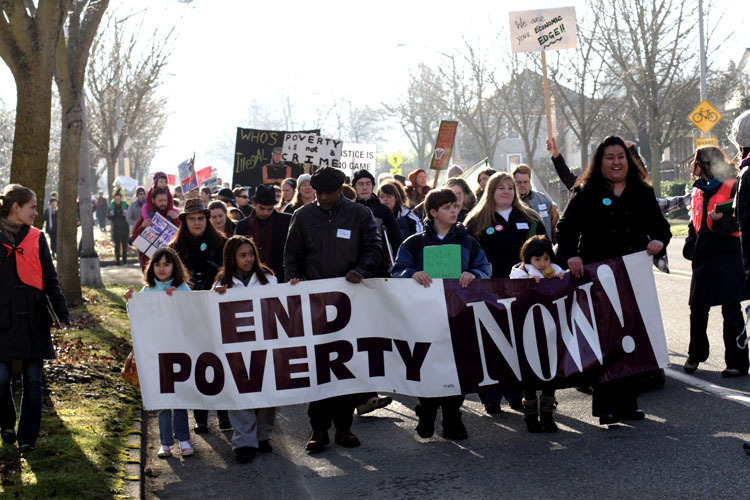
As far as poverty in America, about 36 million are on the poverty level.  There isn’t enough food for everyone; crazy thing is we waste food-about 100 billion Ibs. a year. As far as minimum wage, American workers age 16 and over were paid $7.25 per hour, it increased a little yet 3 million were still under the wage.  With income, some people face problems while others kind of have it easier. The upper class owned at least thirty six percent of all privately held wealth and as far as the other nineteen percent has about half- fifty to fifty five percent. This group consists of professionals: lawyers, doctors, psychologists, government people, etc. The lower class owns fifteen percent for a major group of 80%.-also known as the minimum wage workers, etc. (You can visit
http://www.massappealnews.com/wp-content/uploads/2010/09/End-Poverty-in-America.jpg for picture-check out poster, says: "End Poverty Now.")


Sunday, August 14, 2011

Turning A Blind Eye


Submitted by: Tyniasha Womack
Poverty has always been a touchy subject for me, because as I sit at this computer and type this blog, I still have neighbors and relatives who have no idea where their next meal will come from.  I still have neighbors and friends who won't turn in their homework tomorrow. Not because they're lazy, but because electricity is a luxury they can't afford right now and free libraries in our neighborhoods have either closed down or cut back hours drastically. In this blog, I will define poverty and explain why welfare is an inadequate solution to the problem.  I will give statistics on poverty in my hometown of Philadelphia.  I will attempt to challenge assumptions about why poverty still exists in what many consider to be the greatest country in the world.  Last but definitely not least, I will post a video where Marian Wright Edelman will elaborate on what poverty means for the large amount of people struggling for America's attention and how if we show a little humanity, it can be eradicated.
Businessdictionary.com defines poverty as a condition where people's basic need for food, clothing, and shelter are not being met.  It is mind boggling to me that this country can find the time, energy, money, and resources to put a man on the moon, but can't find the time, energy, money, and resources to house and feed its own citizens.  We can focus on which is more difficult, but we SHOULD focus on which is more important.  According to an article by Alfred Lubrano, "The Portrait of Hunger", many choose not to apply for government subsidies (public housing, food stamps) because they are either treated like criminals or attacked for taking advantage of the government's help. Many others are simply uninformed about the programs.  Furthermore, welfare guidelines are strict and unfair, leaving many employed Americans who can afford a place to live in this recession in dire need of other things, like food and clothing.

 Poverty in Philadelphia: 1 out of 4 Philadelphians lived below the poverty line in 2009,  according to the U.S. Census Bureau, a rate far higher than the national average of 1 in 7.  Even more upsetting, 1 in 3 children in Philadelphia are poor, compared to 1 in 5 children nationally.  That's 44,000 children under the age of 6, which is enough to fill Citizen's Bank Park to capacity. 
I've heard them all and I know you have too; the common misconceptions and generalizations that the poor and poverty ridden are lazy.  What amazes me is that the same groups of people who are considered to be lazy are the same group of people with the highest rate of incarceration.  Are the police knocking down the doors of people who never get out of bed?? Or are these people out there trying to make a living to support themselves and their families and are given a hard time about it??  Just recently on my way home from school, I witnessed a man selling waters by the side of the road being harassed by a police officer.  The officer wanted to see his peddlers license, but the man didn't have one.  The only real crime the man committed was making money and not giving the government a cut.  When the police officer left, the man packed up his belongings and headed to the opposite corner, in hopes of avoiding harassment, and having a supplemental income to make ends meet as legally as possible.  People in these situations have the same intestinal fortitude as the millionaire, but we don't judge people by how much heart they have, only by how heavy their pockets are.

"I never saw a wild thing sorry for itself" -D.H. Lawrence. 


Monday, August 8, 2011

Soundtrack to a Riot; A Life of Poverty

Taylor Roloff

Poverty is an issue that not only affects our homes, communities and our country, but the entire world. According to Websters Dictionary, poverty is defined as the state or condition of having little or no money, goods, or means of support; a deficiency of necessary or desirable ingredients and qualities.
A recent FAO news release (the food and agricultural organization) stated that 925 million people do not have enough food to eat. To contextualize that number, that is more people than the populations of the USA, Canada and Europe, combined. It is estimated that 1 in 7 people, globally, are malnurished.  Something I appreciate about education is the ability to apply knowledge on a global scale. From my perspective, I see that individually we struggle to remove oursleves from our own personal context and apply it to a larger image, or more global perspective. As a whole, I think we can all attest to the fact that people struggle. Some have and some do not and as a child I remember wondering why that is. Why is it that some folks can have "it all", while others barely survive? Recently in class we have been discussing social facts and how that applies to poverty in our own community; Philadelphia, PA. The video that I have posted bascially depicts a complete parallel in struggles we face here at home, but instead in Paris, France.  My perspective was completely blown away at the fact that these individuals, these citizens, are fighting a similar battle. Their private troubles are the same; poverty, lack of resources, feelings of isolation, insecurities surrounding ethnicity or social location and the need to find some level of a release or social expression.
If that is the case, and their personal troubles are similar to ours, wouldnt it be safe to say that we have a larger societal issue in front of us? Poverty isnt something that is only happening in the First Congressional District, but yet all over the world. This video brought up an overwhelming feeling of global connection for me. It made me smile, not because people are angry or fighting for life, but that there are others just like me all over the world refusing to give up. These individuals are speaking up and attemting to have their voice heard. They are living in an enviornment that is unacceptable and until we all unite and recognize that we are all in it together, the issue of poverty will persist.

*Make sure to click on the red 'watch video' button. i struggled with the copy and paste.


Friday, August 5, 2011

The Argument: Poverty doesn't = crime...yes it does!

Submitted by Prentice Vann:      

          Poverty equaling crime is a debate to many, not a fact. Some think that crime is committed by choice and not circumstance. Their argument is that poverty doesn't make one commit racist murders and rapes. Rapes would make a good argument against poverty breeding criminal activity. Does poverty create rape? Does poverty create showing off at events or for the opposite sex at events? At the same time, does poverty breed drug dealing or robberies? It probably depends on the individual. We3 can debate all day but both points of views can make a point in our society.
              In these first two videos, the view of crime being of one's intentions is expressed. The two individuals, a white person from America and a black person from  Africa, agree that crimes committed by people are of the nature of the individual. People commit crimes because they want to, so they say. The African says that it's due to respect. We know of a certain level of crimes in the US due to respect. An example would be the murder of someone approaching your lover, knowing that you two are together. Also, physical harm done to someone disrespecting your mother, spouse, or child in any matter.
           Others say that (some) crime is brought about by circumstance. The rent needs to be paid and the children, and self, need to be fed. Would someone that would not commit murder commit murder in self-defense? How about if her/his children are there? The government even judges crimes by their purpose. A premeditated murder would result in giving out more prison time than manslaughter. The individual in the video on the right mentions the need of money as a reasonable reason to sell drugs. He also expresses he feelings toward over doing it. He basically say that if one does what he/she does to get what they need, or achieve a level of advancement, they should stop their crimes. One thing that we all should agree on is that our children need to be fed. That would be most of our breaking points.